

Projects
/
Interactive Tangible Content Exploration Table
Overview
At a global international education fair, XCL World Academy aimed to present its academic philosophy, programs, and student opportunities in a way that would stand out in a crowded exhibition environment. Traditional brochures and static displays often fail to capture attention or convey complex institutional information effectively.
To solve this challenge, an interactive tangible interface was designed and developed to transform complex institutional information into a simple, engaging, and intuitive experience. The installation combined physical objects, touch interaction, and RFID technology to create a hands-on discovery journey for visitors.
The objective was clear: make exploration of the academy’s offerings interactive, memorable, and easy to understand within a short engagement time typical at large fairs.
The Challenge
Education institutions often need to communicate a large amount of information—academic programs, facilities, global opportunities, curriculum structure, and student life. At exhibition environments such as international fairs, visitors typically spend only a few minutes at each booth.
XCL World Academy needed a solution that could:
• Simplify complex information into quick, digestible interactions
• Encourage visitors to physically engage with the booth
• Support conversations between school representatives and parents/students
• Present multimedia content without overwhelming users
The solution had to be visually attractive, technologically reliable, and simple enough for anyone to use without instructions.
The Solution
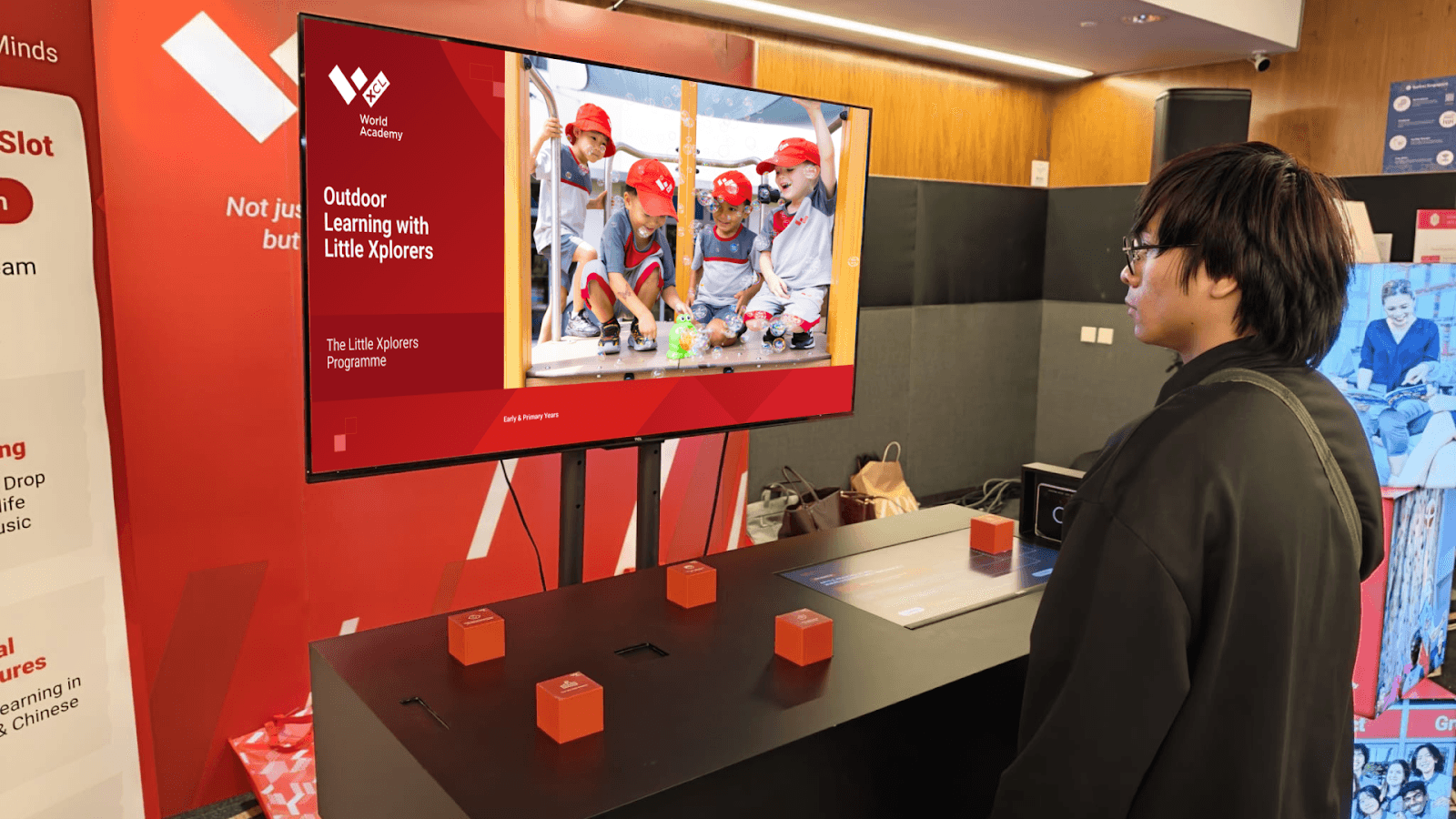
A tangible interaction system was designed where physical cubes representing different topics could be placed onto an interactive table to reveal related content on a larger screen.
Instead of browsing through menus or tapping through multiple pages, visitors interacted with physical objects to explore information. Each cube represented a key theme such as academics, facilities, global exposure, student life, or admissions.
The experience was structured around a two-screen system:
1. 32-inch Touchscreen Table Interface
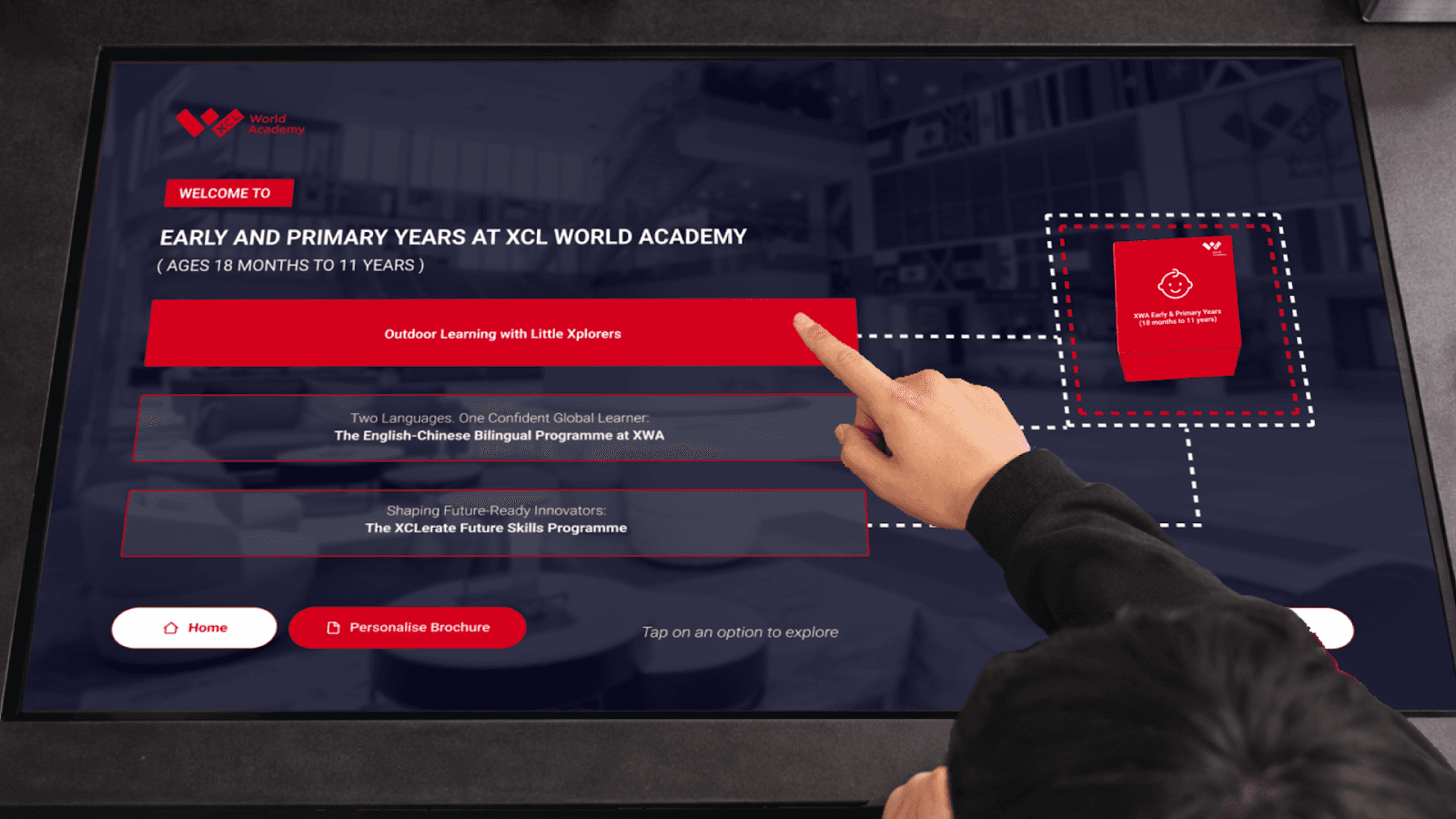
A compact touchscreen embedded in the table acted as the primary interaction surface. The screen displayed a visual interface with clearly marked zones where users could place the cubes.
2. Large Display Screen
A larger screen positioned behind the booth displayed rich multimedia content—videos, images, and key messages—based on the cube placed on the table.
This two-layer interaction allowed users to control the experience at the table while the audience could view the content on the larger display.
How the Interaction Worked
The installation used a tangible user interface model, where physical interaction triggered digital content.
Visitors picked up a topic cube placed on the table.
Each cube contained an RFID tag corresponding to a specific topic.
When the cube was placed on the designated interaction zone on the touchscreen table, the table’s RFID reader detected the tag.
The system identified the cube and triggered the corresponding content.
The selected topic instantly appeared on the large display screen, presenting videos, visuals, and structured information.
The result was a simple but powerful interaction: Pick a cube → Place it → Discover the story.
Hardware Components
The system was built using a combination of reliable exhibition-grade hardware.
Interactive Table System
• 32-inch touchscreen display
• Embedded RFID reader integrated under the table surface
• Custom interaction interface software
Physical Interaction Objects
• Custom-designed cubes representing content topics
• Printed topic stickers on each cube
• Embedded RFID tags for identification
Content Display
• Large LED display screen for presenting multimedia content
• High-resolution visuals and videos aligned with each topic
Processing & Control
• Dedicated computer system running the interaction software
• RFID integration layer for cube recognition
• Real-time content triggering and synchronization between the table and the large screen
Content Design
The content was carefully structured to deliver meaningful information quickly. Each cube represented a key area of interest for prospective students and parents.
Example themes included:
• Academic Programs
• Learning Philosophy
• Campus Facilities
• Global Opportunities
• Student Life
When a cube was placed on the table, the larger screen displayed a curated content sequence including visuals, short videos, and key points explaining the topic.
This storytelling approach helped visitors grasp the academy’s offerings in under a minute per interaction.
Visitor Experience
The installation attracted visitors naturally due to the physical cubes and interactive table. The tactile nature of the experience encouraged curiosity—people wanted to pick up the cubes and see what would happen.
Key advantages of the experience included:
• Self-guided exploration without requiring staff explanation
• Physical engagement, which increased dwell time
• Group-friendly interaction, allowing families to explore together
• Clear visual storytelling on the larger screen
The system also supported school representatives who could guide conversations using the cubes as prompts.
By combining tangible interaction, RFID technology, and multimedia storytelling, the installation created an intuitive and memorable way to explore information about XCL World Academy.
The project demonstrates how physical interaction and digital content can work together to transform traditional exhibition booths into immersive, participatory experiences—making learning about an institution not just informative, but engaging and enjoyable.